The TRACE model defines the entities and relationships required to describe and represent Transparent Research Objects (TROs) and the Trusted Research Systems (TRSs) that produce them.
This section describes the current revision of TRACE conceptual model in detail. The model is demonstrated via the trace-model repository and implemented in the TRACE Prototype service.
A Transparent Research Object (TRO) is a pairing of a TRO declaration and a TRO composition.
The TRO composition comprises all of the digital artifacts and (potentially unpersisted) bitstreams that the TRO declaration describes.
The TRO composition does not include the TRO declaration that describes it.
Any number of TROs can share the same TRO composition.
A TRO declaration and the TRO composition it describes can be stored and shared separately or together, and different components of the TRO composition may be stored separately and shared independently
Example: If a TRO declaration is stored in a single archive (e.g. zip) file together with other digital artifacts, the TRO composition is not equivalent to the contents of the archive file. The TRO declaration in this case may describe all of the contents of the archive other than the TRO declaration. Or it may describe only some of the contents of the archive; or it even may describe artifacts not included in the archive at all.
The TRO composition referred to by a TRO declaration is uniquely identified by a TRO composition fingerprint (or composition fingerprint)
A composition fingerprint is a digest over a concatenation of the sorted digests of the individual digital artifacts and bitstreams comprising the TRO composition.
A composition fingerprint is independent of artifact (e.g. file) names and resource paths identifying or locating the artifacts.
A TRO declaration minimally includes (expressed in TRACE vocabulary):
The unique ID and public key of the Trusted Research System (TRS) that digitally signed the TRO declaration.
The composition fingerprint.
A TRO declaration timestamp (or declaration timestamp) indicating when the TRO declaration was signed by the TRS.
The URL and public key of the authorized timestamp server that provided the timestamp.
A TRO declaration optionally (and almost alway) will includes:
TRACE-vocabulary expressed claims about the associated TRS. Typically this will be a complete copy of the TRS certificate.
TRACE-vocabulary expressed claims about this specific TRO.
List of and means to identify each of the individual digital artifacts and bitstreams comprising the TRO composition. E.g., for each artifact in the TRO composition:
Zero or more resource paths (e.g. file names) associated with the artifact.
A digest of the bits comprising the artifact.
A TRO declaration on its own cannot prove that it (the TRO declaration) was produced by the TRS it claims produced and signed it.
Instead, this proof is provided with a digital signature of the TRO declaration which is delivered as a separate TRS signature file.
A TRS signature is conceptually equivalent to an encrypted digest of the contents of TRO declaration (not the contents of the TRO composition), where the encryption is performed using the private key of the TRS.
Verifying a TRS signature is conceptually equivalent to decrypting the encrypted digest of the TRO declaration and confirming that the decrypted digest is in fact the digest of the TRO declaration.
Verifying a TRS signature proves (1) that the TRS signature was produced by a particular TRS, and (2) that the TRO declaration is bit-for-bit identical to the TRO declaration that the TRS signed.
Because a TRO declaration must include the composition fingerprint that identifies the artifacts it describes, the TRS signature additionally proves that the TRS intended to associate the TRO declaration with the TRO composition identified by the composition fingerprint.
Because the validity of a keypair associated with a TRS may be limited in time, either due to scheduled expiration or explicit revocation, the date on which a TRS private key was used to sign a TRO declaration must also be established authoritatively.
A TRO declaration, and the associated TRS signature file, together must be time-stamped by a Time Stamping Authority (TSA, see RFA 3161 TSA), such as https://
www .freetsa .org, which typically will be managed independently of the TRS. A TRS generates a signed timestamp for each TRO it endorses by sending a digest of the concatenation of the TRO declaration and the TRS signature to a TSA and stores the response from the TSA in a Trusted Timestamp file that subsequently can be used to verify that the associated TRO declaration and TRS signature files were not modified since they were timestamped.
A TRO declaration may optionally specify one or more artifact arrangements. An artifact arrangement specifies the location of one or more of the artifacts included in the TRO composition. Multiple locations for a single artifact may be indicated by including it in multiple arrangements.
A TRO declaration additionally may specify one or more research performances. A research performance may access (read data from) one or more artifact arrangements, and contribute to (write data to) one or more other artifact arrangements.
Example: The execution of a single program on a set of input files to produce a set of output files can be represented as a single research performance (the program execution) that accesses (the input files in) one artifact arrangement and contributes (the output files) to another artifact arrangement.
The trustworthy characteristics of a research performance may be enumerated by assigning to it one or more performance attributes that indicate the conditions guaranteed by the TRS during that performance. Each performance attribute assigned to a research performance must be warranted by a corresponding TRS capability that was declared within the TRS certificate at the time the latter was signed.
Example: Assigning the performance attribute “internet isolation” to a research performance (making the claim that the performance was carried out in isolation from the Internet) also requires specifying the corresponding TRS capability that warrants this claim (e.g. “internet isolation capability”), that in turn must be enumerated within the signed TRS certificate (along with all the other certified capabilities of the TRS).
Instance examples
The following examples illustrate different possible configurations of a TRO.
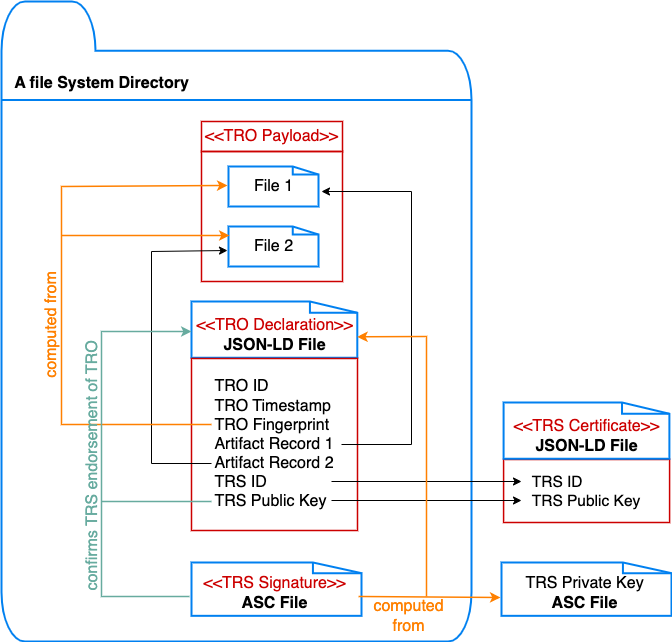
Figure 1:A TRO with a payload of two files in a filesystem, along with a TRO declaration in the same directory. Emphasize that the TRO declaration is not part of the payload.
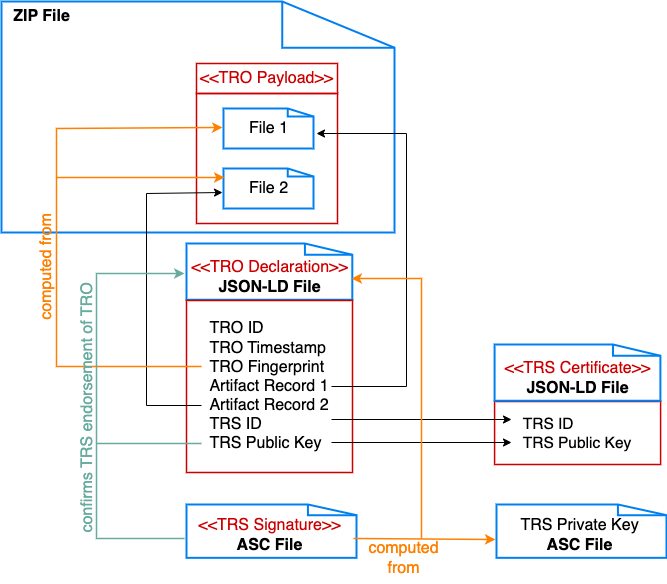
Figure 2:A TRO with a payload of two files stored in a single zip, where the TRO declaration is outside of the zip file.
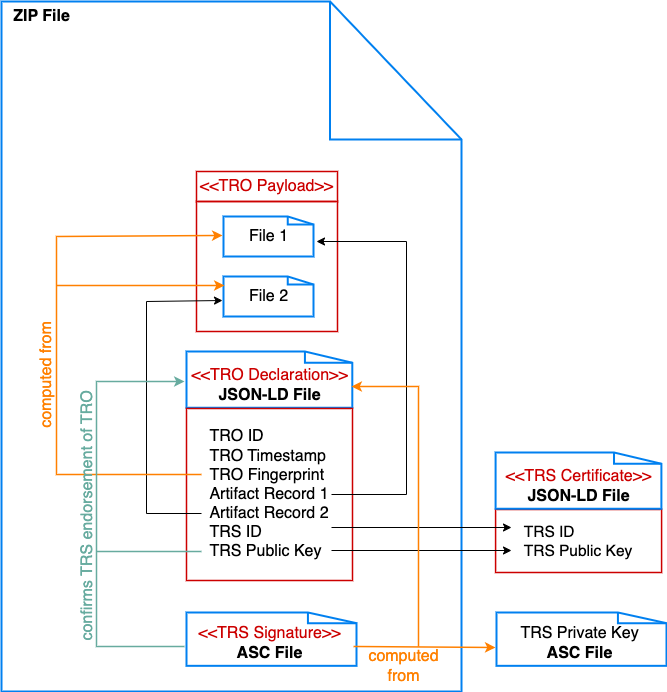
Figure 3:A TRO with a payload of two files stored in a single zip, where the TRO declaration is inside the same zip file. Emphasize that even though the declaration is in the zip, it is not part of the payload, and does not contribute to the fingerprint.
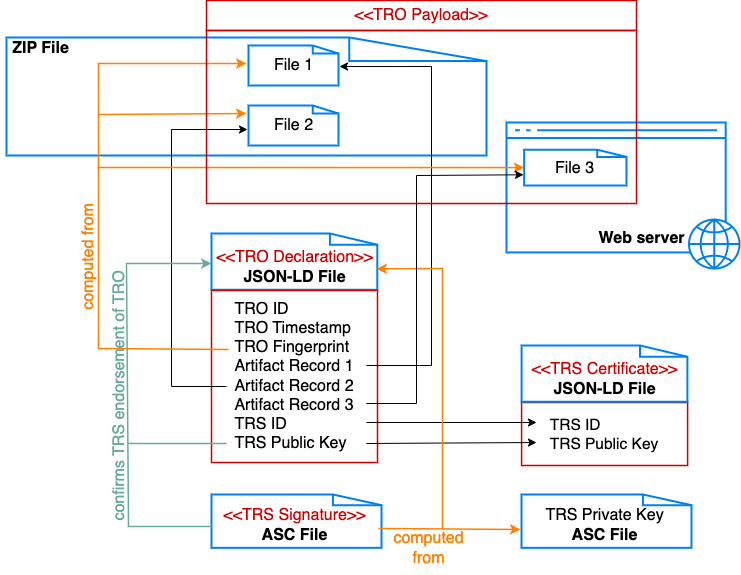
Figure 4:A TRO with a payload of three files, two small files in a zip file, and a third huge file on a web server (500 GB datafile).
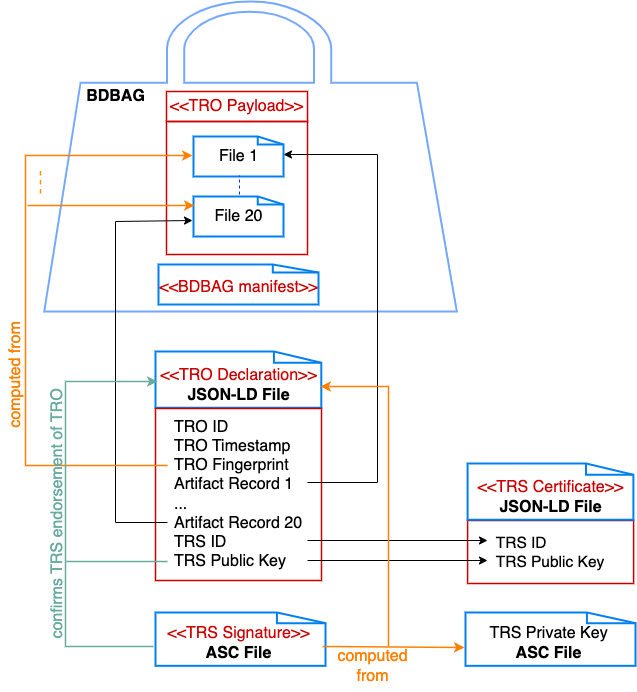
Figure 5:A TRO with a payload of 20 files in a BDBAG. The TRO declaration includes a TRO Artifact Record for each of these 20 data files in the BDBAG, where each record has a file path and a digest.
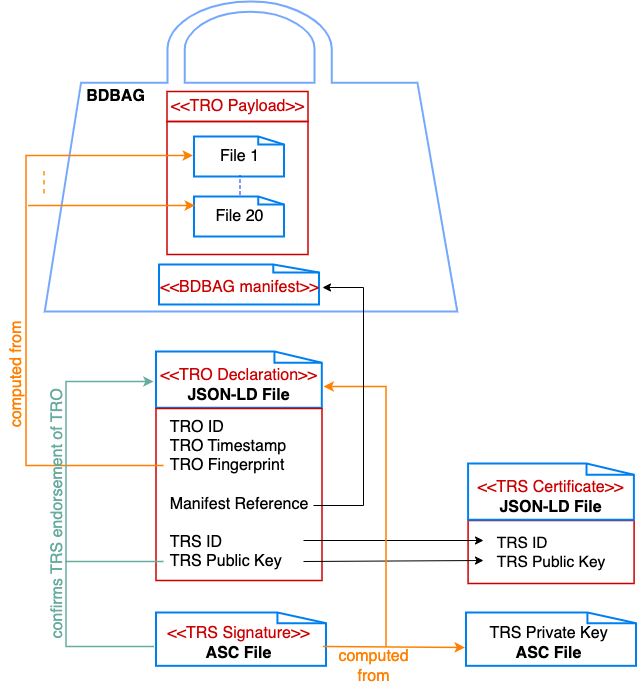
Figure 6:A TRO with a payload of 20 files in a BDBAG. The TRO declaration contains NO artifact records, but instead refers to the BDBAG manifest.
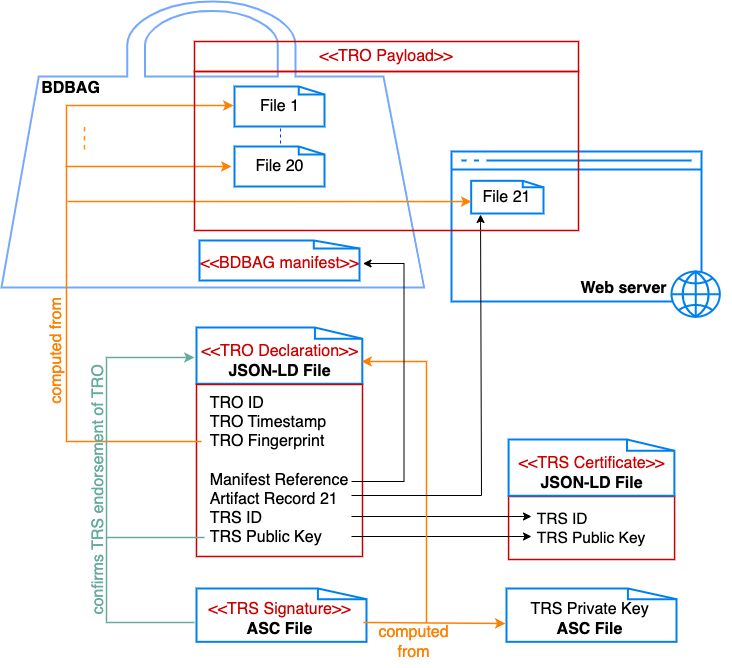
Figure 7:A TRO with a payload of 21 files, where 20 files in a BDBAG and one huge file on a web server. The TRO declaration refers to the BDBAG manifest, and declares an additional Artifact Record for the 21st file.